What ? W a ?s I Looking At ?Again? :/:):(: o
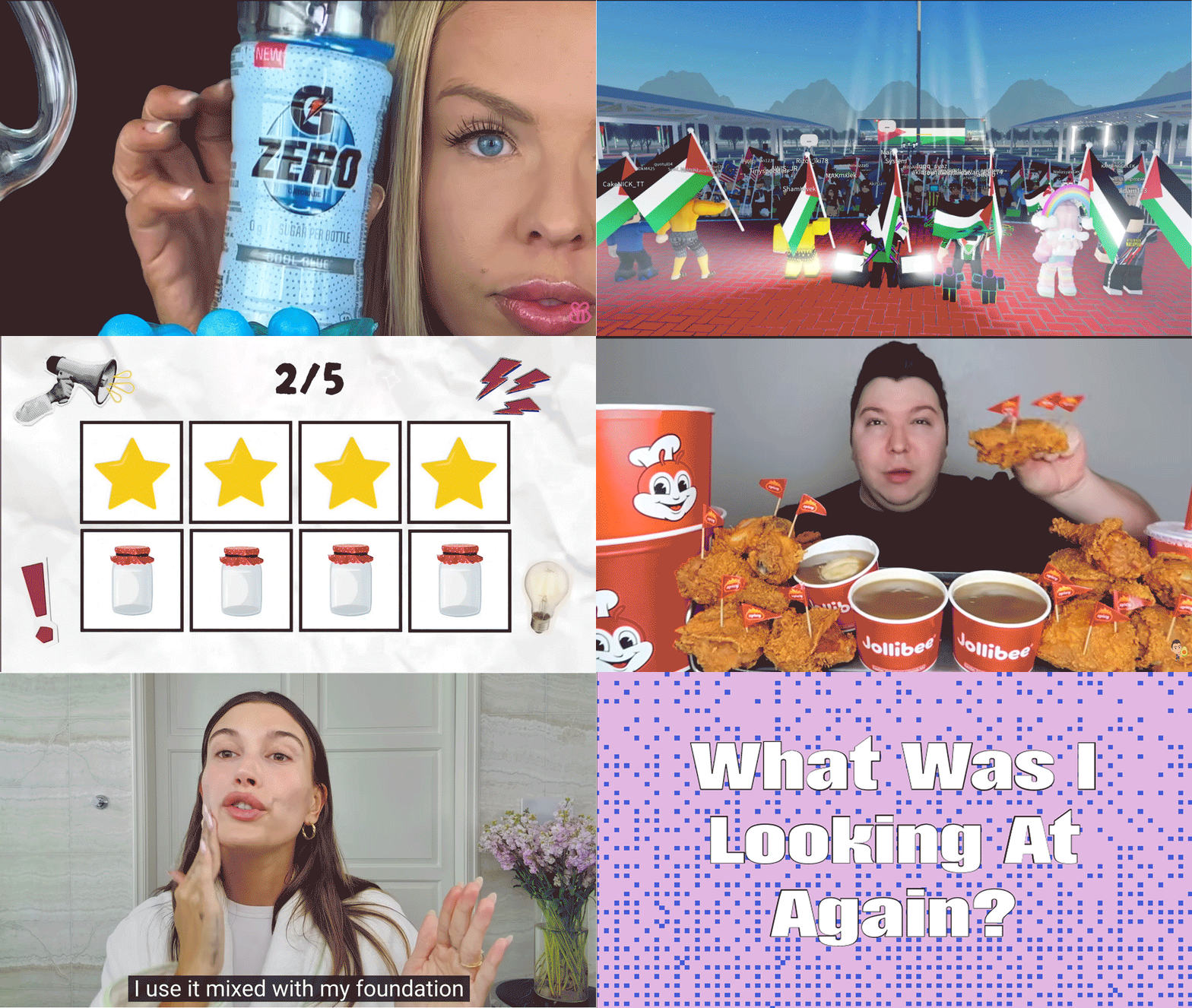
It’s 2026 and if you’re feeling overwhelmed, you’re not alone. Over the past decade, the structure of social media has changed completely. In 2016, the introduction of Instagram’s algorithmic feed on top of its infinite scroll spurred a massive shift in how we consume online media, saying goodbye to its reverse-chronological feed. Just a couple of years after that, the influence of computational models was further exacerbated by the proliferation of TikTok’s For You Page, presenting recommended content rather than media from accounts or pages that one already chose to follow.
We've known for a while now that social media platforms created by Big Tech companies are designed and redesigned to capitalise off our attention spans for as long as possible. It may come as no surprise that before founding Instagram, co-founder Mike Krieger followed a class on “captology”, learning about computers as persuasive technologies. Fast forward to today, and what we experience on these platforms feels like increasingly fleeting and fragmented quicksand. Because by the time you’re done consuming your last piece of content, you’ve probably already forgotten where you started. And even attempts to resist these addictive technologies are outsourced to products we are sold, ranging from screentime limiting on smartphones to add-on physical objects like Tap Out and Brick.
Not all narratives, forms of storytelling, or information fit neatly within the constraints of these platforms. Creators are incentivised to make content that performs well and conforms to constantly changing algorithmic rules and expectations. As consumers, the ways we perceive and process have been subtly, and not so subtly influenced by scrolling through ever-accelerating feeds. Even how we think is being molded by these technologies. As just one example from the early days of Twitter (rip), users would notice that they would start thinking in max 140 chars. And that was two decades ago.
But is this potential rewiring of our brains necessarily a bad thing? Or are we seeing a shift away from linear text-based media forms that have organised much of modernity? And not to mention the speculations that short form video formats pushed by various platforms are ushering in a new age of orality, even more than the television did.
Where social media were once seen as democratising means—providing anyone with a smartphone and internet ways to amplify their voice—one can also see how a handful of Big Tech companies now engineer the absorption of dissent, deciding who gets prioritised and who gets shadowbanned. This, in combination with their addictive tactics, consolidates a huge amount of power and influence in just a few soft corporate hands—partly at the cost of legacy and public media like TV and newspapers, which despite their own flaws, are probably easier to keep accountable than alt-right pipeline influencers and their Big Tech counterparts.
For this year’s thematic focus, The Hmm will be looking at how schemes of organising and disseminating information have changed consuming, perceiving, and thinking. Are they all just harvesting tactics to regurgitate our own data back in our shiny flat mobile bowls, or are there alternative ways to understand and navigate these dizzying media labryinths?
Stay tuned for the spring and autumn Symposihmms, where we'll harness the liminal seasons to deep dive inbetween those winter arcs.
And scroll further for our 2026 open call, a cute ((literally)) event on 18 March, and more. You might just be featured on our website or a hybrid stage in Amsterdam.
Stay cute and don't look back,
The Hmm
2026 open call for What Was I Looking At Again?
With our year theme What Was I Looking At Again?, we want to explore the dizzying, attention-scattering effects of algorithmically driven online experiences.
Through this open call, we aim to amplify:
- meaning-making in the midst of the slop flooding our feeds,
- ways to escape or resist the platforms that so tactically capture our attention, and
- ways to navigate the new age of orality that viral short form video might be ushering in
We welcome contributions that reflect upon this topic both critically and playfully. Your proposal can be submitted for the following:
-
for featuring on our website’s year theme dossier
- written text, max 3000 words
- visual contribution in the form of a (series of) video(s)
- an interactive webpage
- a quiz
- a series of infographics, etc.
-
for possible programming spots during our 2026 spring and autumn hybrid Symposihmms (Amsterdam and online)
- performance
- workshop
- or a form that may not neatly fit within the above
If we choose your proposal, we have a fee of €500 (excl. VAT) available for your work. The deadline to submit your short proposal is 29 March through the link below.

Event: Wed 18 March: Soooo cute ૮ ˶ᵔ ᵕ ᵔ˶ ა (Amsterdam & online)
From the self-infantilisation trends we explored last year, like the viral phrase This is who you’re being mean to accompanied by a cute animal, to viral capybaras, baby cats, and uwu-filters, cuteness is everywhere. How does it work so well online, and what does it do with us?
In their book Cute Accelerationism (2024), Amy Ireland and Maya B. Kronic describe cute as a powerful force that seduces us through softness. Cuteness offers another way of thinking through change, through pleasure, vulnerability, and shared joy as opposed to apocalypse and collapse.
We’re excited to welcome Amy and Maya to Amsterdam for a workshop (onsite only), followed by a hybrid performance-lecture.
Defining cute: a workshop
How can we define cute? How many forms can it take and to what sensory domains does it belong? And where does it begin and end? We will map how cuteness moves through bodies, images, sounds, and emotions through listening exercises, participatory drawing, and collective reflections.
The power of cute: a performance-lecture
In an A/V performance based on Cute Accelerationism, Amy and Maya dive deep into the strange life of cute — its history, biology, psychology, and cultural power. They explore cute as a feeling, visual style, social strategy, and a seductive force giving shape to contemporary culture.
Stuff you should know
Date: Wednesday 18 March 2026
Location: post-office, Hoofdweg 403 Amsterdam and online via The Inbetween
Times:
- 16:00 - 18:00 Defining cute (workshop) @ post-office
- 18:00 - 19:30 Dinner break
- 19:30 - 21:00 The power of cute (performance-lecture) @ post-office and online
Tickets: workshop €12,50 (students €9,50); performance-lecture €8 (students €5, interactive livestream €5)

The big Big Tech vs Alternatives survey
Many of the tools we use every day—from cloud storage to social platforms and AI—quietly run on vast, energy-hungry infrastructures. Hidden behind smooth interfaces are data centers, servers, and corporate platforms that store our work, shape our visibility, and influence how culture circulates.
With The big Big Tech vs Alternatives Survey we want to understand how artists, designers, and cultural workers navigate this landscape. How do you feel about working on platforms owned by Big Tech? Do you see possibilities for more sustainable, independent, or experimental digital practices? Where do you already resist, adapt, or imagine something else?
Your answers help us to map how creative communities relate to the digital systems that increasingly define how we work, share, and survive online. This is part of Connecting Otherwise, a research project we’re doing in collaboration with Rietveld Academy as part of the scheme Artistiek en Ontwerpend Onderzoek by Regieorgaan Sia and the Creative Industry Fund.
We hope you enjoyed this editorial newsletter. Catch you on the ~flip~ side!
Visit your personal preferences page if you'd like to change how you receive this newsletter. Or, if you must, opt-out completely from all future mailings :-(